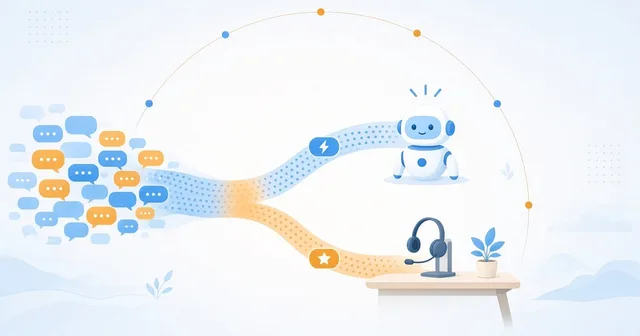
An omnichannel contact center keeps one case and one history across every channel, while multichannel only opens extra doors that do not talk to each other. Customers feel the difference when they have to retell the story. Shared context, not channel count, decides service quality.
Multichannel: many doors, many restarts
Multichannel means you are present on phone, WhatsApp, email, and social. Each door has its own queue, agents, and notes. From a marketing slide, the channel list looks complete. From the customer’s side, every switch is a restart.
The pattern is common in Indonesia because channels get added campaign by campaign. Ecommerce opens WhatsApp. The card team keeps a voice contact center. Social replies to public complaints. Specialisation is fine. A split case identity is not.
WhatsApp is a dominant business channel in Indonesia. Meta’s WhatsApp Business Summit Indonesia on 11 August 2026 reported that 71 percent of Indonesians message businesses daily, up from 60 percent in 2024 and 66 percent in 2025. If a channel that dense does not carry context into voice, you pay twice for one problem.
Omnichannel: one case, many touches
Omnichannel is not “every channel on one screen”. That is necessary, not sufficient. The difference is a case identity that lives across WhatsApp, phone, email, and forms, with transcripts, attachments, and decisions travelling with it.
An agent taking a bot escalation should see intent, data already collected, and the reason for handoff. A customer who calls after a chat should not be asked for ID and order number again. Supervision should see a timeline, not a silo of reports.
ConverseAIght designs the agent desktop as an omnichannel case timeline, including WhatsApp and voice. Without that timeline, an AI copilot only helps people type faster inside channels that remain fragmented.
Why customers care even when the slide does not
Customers do not use the word omnichannel. They use a sense of fairness. If they already sent a photo of the goods on WhatsApp, being asked to resend it by email feels like a penalty for changing channel.
In financial services, repeating data also feels unsafe. People start asking why the company cannot remember yesterday’s conversation. Trust falls faster than CSAT.
In ecommerce, order status, returns, and complaints often hop from a shop chat to brand WhatsApp to a call center. Without a shared case, each hop adds a conflicting promise. Conflicting promises damage more than a slightly longer queue.
Practical differences on the operations floor
Queues versus cases
Multichannel optimises queue metrics per channel. Omnichannel optimises case age and case ownership. If an agent KPI is “chats closed”, they will close a WhatsApp session even when the warehouse has not finished the job.
Change the weekly question. Do not ask how many sessions were closed per channel. Ask how many unique issues closed without a repeat on another channel.
AI contact center, omnichannel service and compliance notes for Indonesian service leaders.
Every Monday, five minutes.
Knowledge and bots
A multichannel bot copies FAQs into every channel. An omnichannel bot uses the same intents, the same escalation rules, and writes to the same case. That stops WhatsApp promising a refund that voice policy does not allow.
Workforce and quality
Multichannel WFM schedules “WhatsApp agents” and “voice agents” as if they were two factories. Omnichannel WFM schedules skills against intents and languages, then lets the case cross channels. QA must score the journey, not a single recording clip.
A checklist: omnichannel, or just busy channels?
Ask five questions. Is customer identity the same on every channel. Can an agent see prior conversation without hunting three systems. Do bots and humans write to one case. Does the repeat report cut across channels. Does the data-retention rule apply equally to recordings and chat.
If any answer is no, you are still multichannel with a prettier dashboard. Adding channels without a shared case raises coordination cost. That is not a digital transformation.
Indonesia’s UU PDP (Law 27/2022) has been fully enforced since 2024. An omnichannel history is a collection of personal data. Unifying context does not mean keeping everything forever. Retention policy should follow the case, not per-channel folders that never get deleted.
How to move without an endless programme
Do not start with “integrate everything”. Start with the intents that most often cross channels. In many Indonesian operations, that is order status, billing, and complaints already escalated to a human.
Unify identity, timeline, and handoff for those intents first. Then move the next intent. Each unified intent produces evidence: fewer repeats, fewer blind transfers, fewer double promises.
Since 1 July 2025, Meta has charged WhatsApp templates per message, not per 24-hour conversation. Templates sent without case context only add cost. Omnichannel lets a template continue a live case rather than opening a blind new thread.
Telkom Group is integrating Meta Llama into WhatsApp customer interactions, and Telkomsel runs Veronika on WhatsApp, according to Marketing-Interactive on 21 September 2026. An AI agent on the dominant channel is useful only if a human on the next channel can see the result.
Frequently asked questions
What is the difference between an omnichannel contact center and multichannel?
Multichannel opens many separate channels. An omnichannel contact center carries one case and one history into every touch, including bots and humans.
Is a shared inbox enough to call it omnichannel?
Not yet. A shared inbox without case identity only stacks queues. You need a timeline, an owner, and cross-channel repeats that are visible.
Must every agent handle every channel?
No. Skills may specialise. The case must not split. Handoffs should carry context, not only a ticket number.
Does omnichannel require AI?
No. AI speeds up intents that are already tidy. If context is split, AI only repeats questions faster on more channels.
Which channels should be unified first?
Unify the channels customers already use for the same problem. In Indonesia, that is usually WhatsApp and voice.
How do you measure a successful transition?
Measure cross-channel repeats, how often customers are asked for the same data, and first contact resolution on priority intents. Do not measure how many channels are “live”.
Book a demo and see your own contact flows running on ConverseAIght
ConverseAIght