To handle WhatsApp chat volume, a contact center queue should split routine questions for AI from cases needing a person, give handoffs a priority lane, cap concurrent chats per agent, and close every conversation before WhatsApp's 24-hour service window ends. Judge it by time to human and repeat contacts.
The volume is real in Indonesia. Kantar's Business Messaging Usage research, presented by Meta at WhatsApp Business Summit Indonesia 2026, found that 71 percent of surveyed adult internet users in Indonesia message a WhatsApp business account every day, up from 60 percent in 2024 and 66 percent in 2025, as reported by Kompas.com.
This week, Grit Daily (October 15, 2026) covered a field experiment on Alibaba's Taobao. Routine chats handled by AI ran 16.8 percent shorter, but ratings fell furthest when an already frustrated customer was passed to a human.
In other words, chat queues usually break at the handover, not inside the bot. This guide covers seven queue design rules, the metrics to watch daily, and the mistakes that jam a queue when volume climbs.
Why a chat queue is not a phone queue
A chat queue differs from a phone queue because one agent can hold several conversations at once, and the customer is not waiting on the line. They send a message, close the app and come back when a notification arrives.
That is why phone capacity models, which assume one agent per call, do not transfer directly. What you need to count is active conversations, reply turns per conversation and how long each conversation stays open.
WhatsApp adds a hard limit. According to Meta's pricing documentation, a 24-hour customer service window opens and resets each time the user messages or calls the business, and free-form messages can only be sent while that window is open.
1. Measure volume as conversations per hour, not tickets per day
Useful chat volume for queue design is new conversations per hour and inbound messages per conversation. Daily totals hide the peaks, such as the lunch break or the hour after a broadcast goes out.
Separate conversations customers start from the ones your own template messages trigger. Reply waves from a broadcast are predictable, so put them in the shift plan before the campaign is sent, not after.
2. Split AI and human queues from the first message
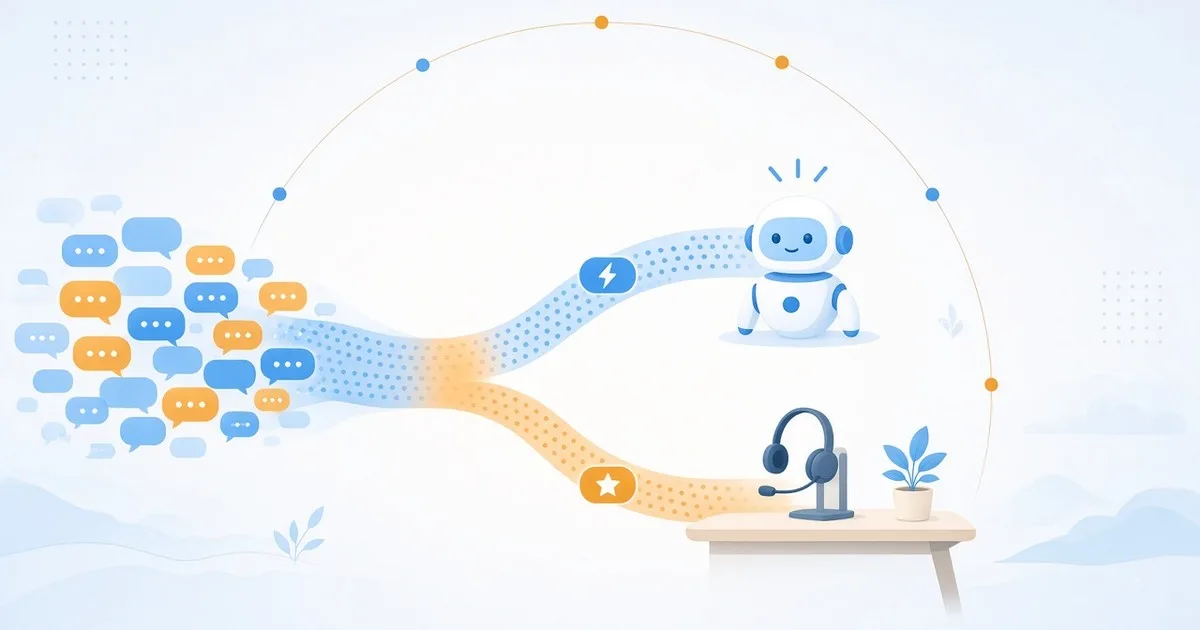
Intent classification on the first message decides which queue a conversation joins. Routine questions such as order status or opening hours go to the AI agent, while disputes, refunds and identity checks go straight to the human queue.
A Five9 survey of 3,000 consumers in the US, UK and Germany, reported by CMSWire (October 14, 2026), supports this split: for high-stakes escalations, 60 percent want a human only. The sample is not Indonesian, but the pattern fits money and identity cases here too.
3. Give handoffs a priority lane
Conversations passed from AI to a human should skip the regular queue. That customer has already spent time with the bot, and every extra minute of waiting adds to the frustration.
The same Five9 survey found 92 percent of respondents give an AI agent less than 10 minutes before escalating to a human. Treat that as a patience ceiling, not a service target: time from handoff request to first human reply should be measured in minutes.
We cover the rules for when a handoff is mandatory in when an AI agent must hand off to a human.
4. Trigger emotional escalations earlier
Escalations driven by customer frustration need to fire earlier than escalations driven by the limits of the AI. In the Taobao study by Wang and colleagues on arXiv, handoffs for technical limits kept ratings on par with human-only chats, while handoffs after the customer became frustrated cut ratings by 0.928 points on a five-point scale.
The researchers also found emotional escalations tended to arrive late, after negative sentiment had built up. Human agents who stepped in at that point sent fewer messages and offered fewer specific fixes.
The practical rule is simple: do not let the bot keep retrying. In the Five9 survey, the top reason consumers leave AI for a person is a bot that repeatedly misunderstood them (46 percent), so a second misunderstanding is enough to trigger a handoff.
AI contact center, omnichannel service and compliance notes for Indonesian service leaders.
Every Monday, five minutes.
5. Cap concurrent chats per agent by case type
The concurrency cap sets the real capacity of the human queue. An agent holding too many chats replies slowly in all of them, and customers experience that as a queue even though their status says they are being served.
Set different caps per queue: looser for simple questions, tighter for handoffs and complaints. In the Taobao study, workers whose routine chats were taken by the AI switched attention less often, and the chats they still handled were rated 0.091 points higher than the control group's.
6. Do not fill the wait with filler messages
Repeated waiting messages now cost money. According to Meta's pricing documentation, Meta resumed charging for service messages per delivered message on October 1, 2026, with a free tier of 1,000 service messages per business phone number each month, while messages from customers to the business are not charged.
Send one honest message instead: the expected wait and what happens next. Three "please hold on" messages speed up nothing, but they add to the bill and to the customer's notifications.
Include this when you calculate the true cost per contact of your WhatsApp channel.
7. Resolve before the 24-hour window closes
Every conversation waiting for a human must get a reply before the 24-hour service window runs out. Once the window closes, the business can only reach the customer with a template message, which is charged by its category.
For night and weekend queues, this means the backlog must clear within 24 hours of the customer's last message. Flag conversations that are close to that limit and raise their priority automatically.
Metrics your queue dashboard should show
A healthy chat queue dashboard shows speed and resolution side by side. These five metrics are enough for a daily stand-up:
| Metric | Question it answers |
|---|---|
| First response time per queue | Do customers feel served quickly? |
| Time from handoff to human reply | Are escalations stuck in the queue? |
| Abandoned conversations | How many customers give up before a reply? |
| Repeat contacts within 7 days | Was the problem actually solved? |
| Conversations near the 24-hour limit | How many risk needing a template message? |
Repeat contacts matter because speed can mislead. In the Taobao study, chats the AI finished with no human help were the shortest, yet they were rated 0.858 points lower. For an honest way to count resolution, see our guide to first contact resolution.
Common mistakes when chat volume rises
- Adding agents without splitting queues, so complex cases wait behind simple questions.
- Sending handoffs to the general queue, so customers already tired of the bot start waiting from scratch.
- Measuring the bot only by chats that never reach a human, without checking repeat contacts.
- Sending many automated waiting messages that add cost without adding certainty.
Design the queue, do not just add headcount
WhatsApp chat volume in Indonesia keeps rising, so adding agents alone will not hold the line. A well-designed queue separates cases early, puts handoffs first and closes conversations before the 24-hour window runs out.
ConverseAIght runs WhatsApp, voice and chat in one contact center with AI agents and human handoff. Book a demo and see your own contact flows running on ConverseAIght.
Frequently asked questions
How many chats can one agent handle at the same time?
A safe number of concurrent chats depends on the case type, not a fixed figure. Start with a tight cap for complaints and handoffs and a looser one for simple questions, then adjust based on each queue's response time and repeat contacts over a few weeks.
Are customer messages on the WhatsApp Business API charged?
Messages from customers to a business are not charged by Meta. Meta charges for delivered business messages, including service messages after the free tier of 1,000 per phone number per month, under the rules in effect since October 1, 2026.
What is the WhatsApp 24-hour customer service window?
The customer service window is a 24-hour period that starts and resets each time the customer messages or calls the business. While it is open, the business can send free-form messages. After it closes, the business can only use template messages.
When should an AI chat be handed to a human agent?
An AI chat should go to a human when the case is beyond the AI, involves money or identity, or the customer starts to get frustrated. Trigger frustration escalations early, because the Taobao study showed late handoffs cut ratings the most.
Which metrics matter most for a chat queue?
The most important metrics are time from handoff to human reply and repeat contacts within seven days. First response time still matters, but without those two a queue can look fast while customer problems stay unsolved.
Book a demo and see your own contact flows running on ConverseAIght
ConverseAIght